The List of Historic Place Names has been in existence for almost five years now, and in that time we've passed several significant milestones. We've doubled the number of names in the List, to just under 700,000, spanning the second century AD to today. This is due to the hard work of our partners in the larger projects like Cynefin and GB1900, to community groups like Menter Iaith Sir Benfro, and to you, the public, for sending us in your place names.
We've briefed the Senedd, and local government, on how the List can support their work, and how the use of historic place names can overcome some thorny issues in and around naming streets and places. Local authorities and a wide range of public bodies in Wales are making use of our data, and the statistics that we've collected suggest that we've been able to make a difference on the ground, with more people choosing to rethink their initial decision to change a historic place name.
We've given dozens of talks to community groups and historical conferences across the country, and you might have heard us talking about place names on Radio Cymru.
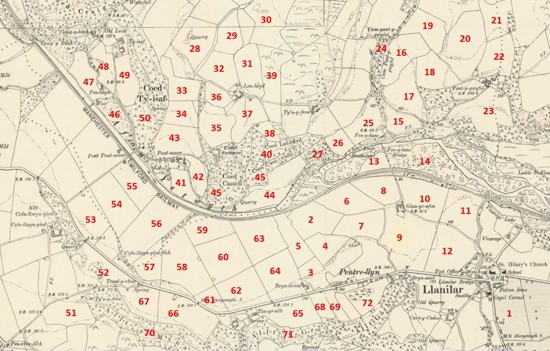
We're very aware, however, that there is still lots to be done. That's why we've launched a user survey on the website, in order to find out how and why you, the public, are using the site, and how you feel that it could be improved. It's vital that as many people as possible respond, so that we can get the best idea possible of how we can work even harder to protect our place name heritage. You can find the survey here: https://form.jotform.com/220324218040338
The names collected by the GB1900 Project are one of the largest groups of names in the List and were one of the first sources included at launch back in 2016. We previously had about 100,000 names from GB1900, between names of houses, crags, streams, woods and others. They were all taken from the second edition Ordnance Survey maps, which were completed between 1898-1908 – one of the maps that you can use whilst browsing the website.
However, it had become obvious that we still had some gaps, particularly in Gwynedd and Ynys Môn, where you could clearly see names written on the map, but without a recorded name point. GB1900 is finished now, having collected millions of names from across Britain, so we contacted them to see what Welsh names remained. After removing the names that we already had there were about 10,000 left, which were uploaded to the List at the start of this month and filled all the gaps – no doubt to the great relief of people in the North-West!
Along with the extra names from the Parochialia that were uploaded recently, this means that the List now holds 680,280 names. As well as this we also have some 13,000 names left from the Cynefin Project which have now been transcribed and are ready to upload, meaning that we are close to having 700,000 names, or to put it another way, that we have almost doubled the size of the List in the five years of its existence.
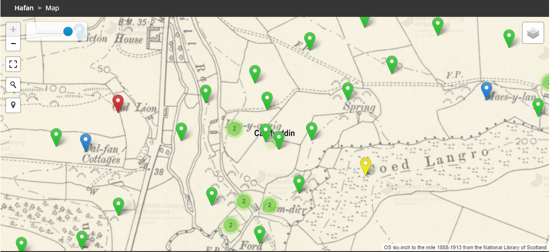
As you might expect, it’s been harder for us to develop the List during lockdown, without all the resources of the office, and with small children running about the house… But despite everything, the work continues. We’ve been concentrating on data cleansing during lockdown, rather than trying to upload more names, and only a few parishes in Carmarthenshire remain to be checked.
As well as correcting existing misspellings and mis-transcriptions we’ve also been working through the remaing dittos from the Cynefin Project, and hope to finish that, and have those 17,000 names ready for upload by Christmas.
We’ve also received a number of names from members of the public, so thank you very much to everyone who has sent in names to us. We’ll be talking more about those names in the next blogpost.
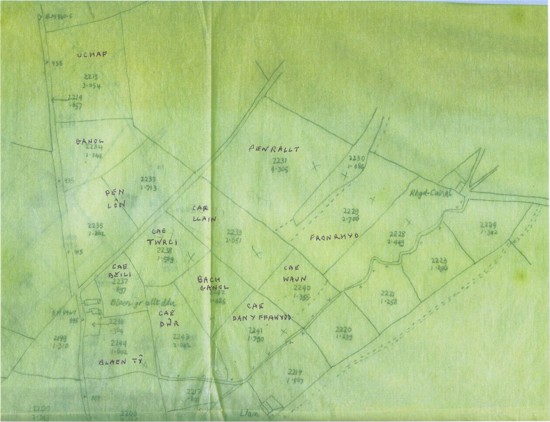
Have you heard about the Cymru1900 project? This was a crowd-sourcing project to transcribe the place names on the second edition Ordnance Survey map of Wales. When we launched the List we received a little over 100,000 names from Cymru1900, and we're very grateful to them for contributing their data so generously. The project was such a success that it was extended to the rest of Britain, becoming GB1900, and before it ended, the volunteers had transcribed over five million place names.
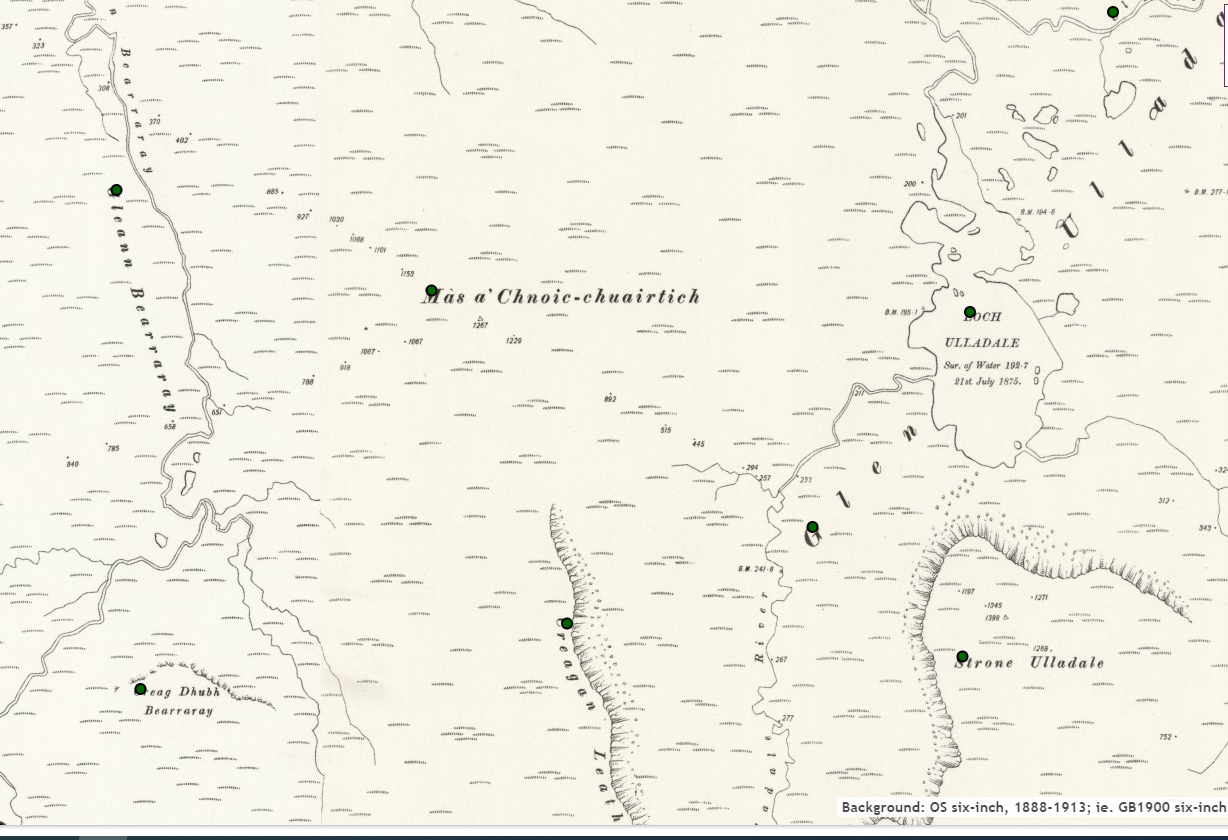 You can see part of Eilean Leòdhais (Lewes), in Na hEileanan Iar (Western Isles) in the picture above. As the work of cleansing our data has continued, we've noticed that some names appear on the 1900 map which are not included in the List. This problem is particularly acute in Ynys Môn (Anglesey) and Caernarfonshire. We decided therefore to go back to GB1900 and get some more up to date data. They make everything available through open access, so many thanks once again to the GB1900 team for their generosity and fantastic hard work! We've stripped out the data from Scotland and England, and are currently removing those names that we've already got from the dataset. Once that's done, we'll be uploading the new names as soon as possible.
Apologies for the deafening silence which has fallen on this blog lately, but there’s a good reason for it! You might remember that we received the rest of the Cynefin Project data from the National Library just before Christmas, and since then, James has been going through them and cleansing the data in order to upload them to the List. This meant going through over 900,000 records, and pulling out each one that wasn’t actually a name, like ‘field’ or ‘house and garden’. This having been done, we’ve got 517,463 names left. These include names in Welsh, English, and a mixture of the two, some of them particularly interesting, such as Cae Dungeon in Glascwm, Radnorshire. Why was there a dungeon in a rural parish? There’s also Maes y Droell in Llanarmon yn Iâl, Denbighsire, which according to local tradition got its name because a woman was killed there with a spinning wheel (troell).
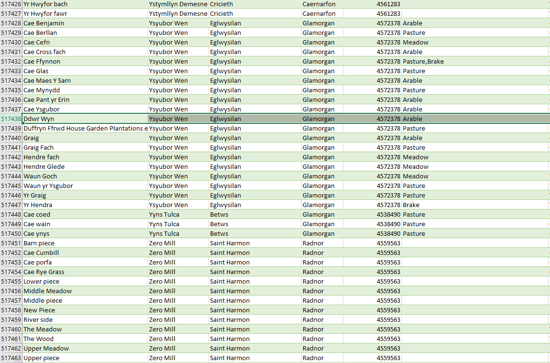
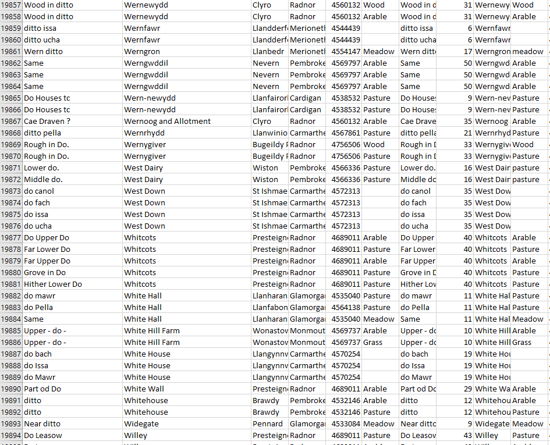
Many people collecting information for the tithe wrote ‘ditto’ rather than repeating names in order to save time. As well as removing the non-name results, James has also been extracting the dittos, and keeping them to one side. There’s a little over twenty thousand of them, all told. Each datum comes with a link to the original tithe key, so replacing the dittos with the real names will be simple enough, and we intend to do this once the first half million names have been uploaded.
We hope to upload these names on Monday, and we’ll be announcing the news on this blog, and on our Twitter account @RC_EnwauLleoedd, so keep your eyes peeled!